What a rainbow needs
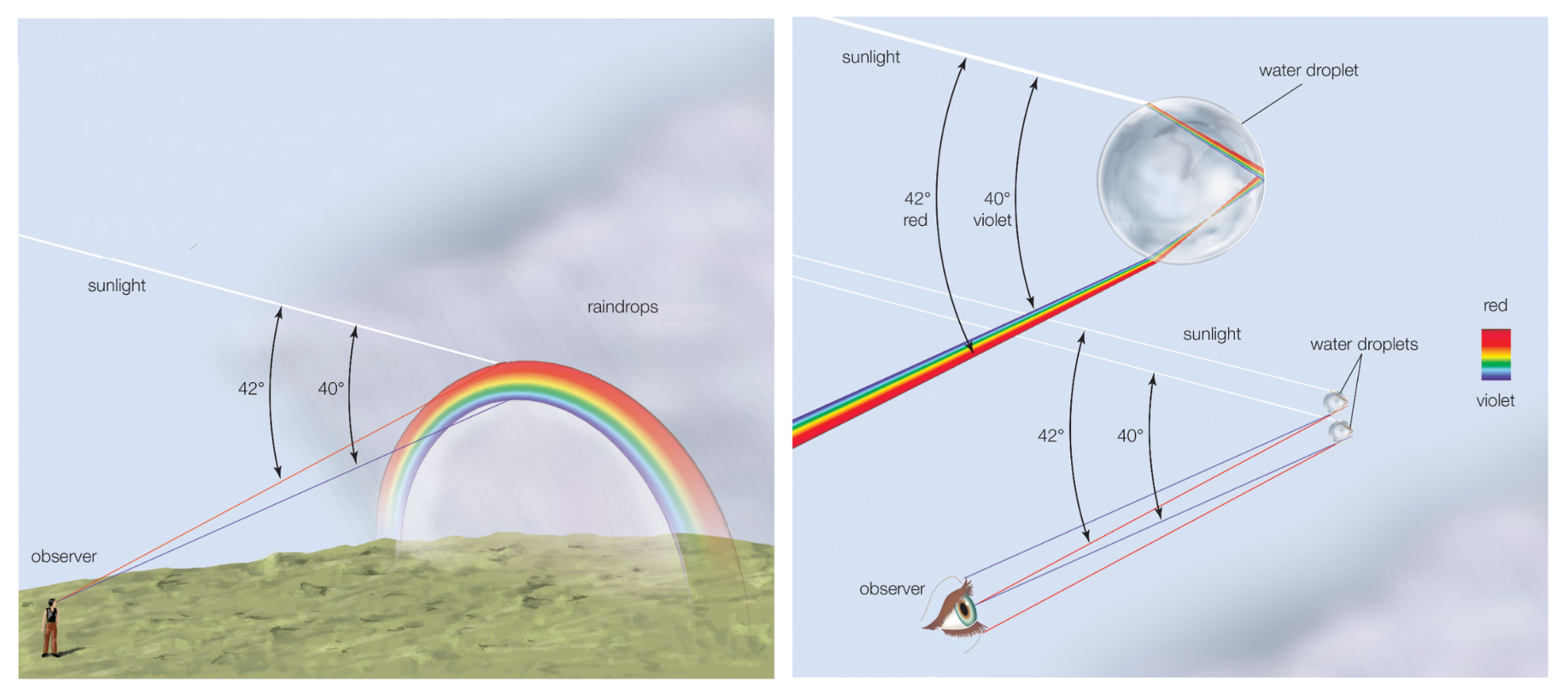
A rainbow requires many liquid droplets that are illuminated by direct light. Light entering such a droplet is refracted, reflected inside the droplet, and refracted again when it leaves. Because the refractive index of the liquid depends slightly on wavelength, the outgoing light is separated by colour. On Earth, this usually happens in water droplets illuminated by the Sun.
The mechanism is not restricted to water. If a different liquid forms the droplets, the rainbow angle changes. On Titan, a moon of Saturn, liquid methane can fall as rain. Methane has a lower refractive index than water, so a methane rainbow would appear at a larger angular distance from the point opposite the Sun than a terrestrial rainbow. Venus is different again: its raindrops consist mainly of sulfuric acid solution. Such droplets have a higher refractive index, which would shift the corresponding bow to smaller angles. The colour separation would also differ, because dispersion depends on the liquid and on the wavelength range of the incoming light.
Why Titan and Venus probably do not show familiar rainbows
The main limitation is direct light. On Titan, visible sunlight is strongly weakened and scattered by the dense haze. On Venus, an observer below the main cloud deck would be shielded from direct sunlight by opaque clouds above. These conditions make a familiar rainbow in the sky unlikely, even though suitable liquid raindrops are present.
Rainbows on exoplanets
For exoplanets, the same physics applies. Planets around other stars could therefore have rainbows if they have liquid raindrops that are directly illuminated by their host star. The colours could differ from those on Earth, for example if the star is hotter and bluer than the Sun, or cooler and redder.
Observing such rainbows would be much harder. With the next generations of telescopes, an exoplanet will be measured as one tiny point of light, without spatial resolution across its disk. Even if, in the far future, a telescope could spatially resolve such a planet, the directions to different points on the planet would still be almost the same for a distant observer. We would therefore not see a local colourful arc like a rainbow in Earth’s sky. Moreover, ordinary rain would often occur below clouds, so from space the raindrops would be partly or completely hidden by the cloud deck above them.
Searching for cloudbows on exoplanets
Cloudbows are more promising than rainbows for exoplanet observations. A cloudbow is produced by droplets near the tops of clouds. Those droplets can be directly illuminated by the host star and visible from space. Cloud droplets are much smaller than raindrops, so the colour bands overlap strongly and the cloudbow appears white. Polarisation filters can make the weak colour separation easier to detect.
For exoplanets, cloudbows, like rainbows, cannot be seen as bow-shaped arcs. Instead, we would search for a peak in the polarisation signal of reflected starlight at a particular phase angle as the planet moves along its orbit. The phase angle is the angle between the observer, the planet, and the host star. The position and shape of this peak can tell us about the type of liquid in the clouds and the size of the droplets. We know from planets in our own Solar System that this method can work: already in 1974, polarisation measurements of Venus as a whole planet, at different phase angles, showed that its clouds are made of tiny sulfuric-acid droplets.
This is where cloudbow physics connects to my research. The total brightness and, even more strongly, the polarisation of reflected light carry information about the size, composition, and shape of cloud droplets. By measuring such scattering features in the light of an exoplanet, we may one day find liquid-water clouds on distant worlds.