Background image
Image: Exploring Earth’s Limb, NASA Scientific Visualization Studio, ID 11901.
Credit: NASA Goddard Space Flight Center, Cover image courtesy of NASA/JSC
Source: NASA SVS: Exploring Earth’s Limb. Downloaded file: c-1920.jpg.
Website credits
This page lists the image files currently used on this website and their credits. Image captions on the relevant pages give short visible credits. This page gives the full source information.
Image: Exploring Earth’s Limb, NASA Scientific Visualization Studio, ID 11901.
Credit: NASA Goddard Space Flight Center, Cover image courtesy of NASA/JSC
Source: NASA SVS: Exploring Earth’s Limb. Downloaded file: c-1920.jpg.
Image: Portrait of Victor J. H. Trees.
Credit: photo by Denis Trees, edited by Karel de Wit.
Image: Adapted rainbow-formation diagram in spherical water droplets.
Credit: Universal Images Group North America LLC / Alamy Stock Photo. Image ID: BCE761.
Source: Alamy licensed image: A rainbow forms when sunlight is refracted by spherical water droplets in the atmosphere, producing the primary arcs of colour.
Licence: Adapted and used under license from Alamy.
Used for: Story page “Are there rainbows on other planets?”.
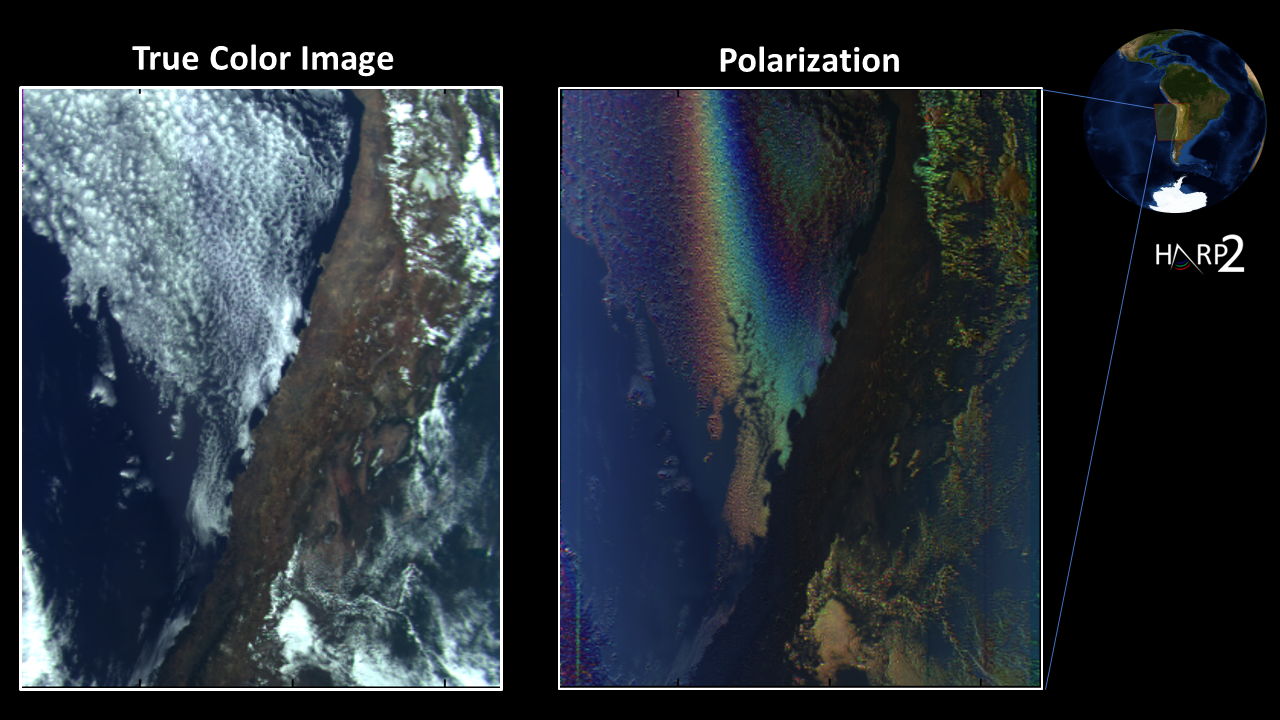
Image: HARP2 first-light image showing a true-colour view and a polarisation view of clouds off the west coast of South America.
Credit: UMBC / HARP2 team, used with permission granted by Cherie Ann Parker (University Communications and Marketing, UMBC).
Source: UMBC story: First light from HARP2 on PACE. Original image file: HARP2-South-America-Cloudbow.png.
Image: Introductory diagram used on the Research page to explain how unpolarised sunlight becomes polarised after reflection by Earth.
Credit: Diagram by Victor J. H. Trees. The slide includes a PACE observatory visual (credit: NASA/PACE) and a SpaceEngine Earth background by Victor J. H. Trees.
Source: NASA PACE mission page. Earth background rendered by Victor J. H. Trees in SpaceEngine.
Image: Book covers used as contextual references for the polarised-radiative-transfer section.
Credit: Cover images of Transfer of Polarized Light in Planetary Atmospheres by Hovenier, van der Mee and Domke, and Light Scattering by Small Particles by H. C. van de Hulst.
Source/context: Used to illustrate fundamental references in light scattering and polarised radiative transfer.
Image: Sketch of the 3D computational domain of MONKI with photon trajectories and local-estimation directions.
Credit: Figure from Trees et al. (2025), prepared for this website from the published figure.
Image: Sketch of the cloud-shadow geometry used in the DARCLOS algorithm.
Credit: Figure from Trees et al. (2022), prepared for this website from the published figure.
Image: Sketch of the solar and lunar disk geometry used in the eclipse-correction method.
Credit: Figure from Trees et al. (2021), prepared for this website from the published figure.
Image: MONKI simulation of intensity and degree of polarisation for a 3D cloudy atmosphere.
Credit: Figure by Victor J. H. Trees.
Source/context: MONKI simulation prepared for this website.
Image: VIIRS true-colour image and DARCLOS actual cloud-shadow flag on the TROPOMI grid.
Credit: Figure adapted from Trees et al. (2022).
Image: Satellite measurements during the 3 October 2005 solar eclipse, before and after correction for reduced sunlight. The coloured lines indicate the fraction of the solar disk obscured by the Moon.
Credit: Figure by Victor J. H. Trees.
Source/context: Solar-eclipse reflectance restoration figure prepared for this website.
Image: Copernicus Sentinel-5P, Europe's air-quality monitoring mission, observing Earth.
Credit: ESA/ATG medialab.
Source: ESA: Sentinel-5P operations. Image credit/licence information: ESA Multimedia: Copernicus Sentinel-5P: Europe’s air quality monitoring mission. Licence: ESA Standard Licence.
Image: Venus as seen by NASA's Mariner 10 spacecraft as it sped away from Venus in February 1974.
Credit: NASA/JPL-Caltech.
Source: NASA Science: Venus Facts.
Image: MONKI simulations with cloud fields from MicroHH, a large-eddy simulation cloud model, at different horizontal resolutions.
Credit: Figure adapted from Wiltink et al. (2026).
Source: Wiltink et al. (2026), Atmospheric Chemistry and Physics. Licence: Creative Commons Attribution 4.0 License.
Image: Conceptual illustration of why cloud-shadow effects can cancel in the TROPOMI absorbing aerosol index.
Credit: Figure adapted from Trees et al. (2025).
Source: Trees et al. (2025), Atmospheric Measurement Techniques.
Image: Conceptual model of surface cooling and shallow-cumulus response during a solar eclipse.
Credit: Figure adapted from Trees et al. (2024).
Source: Trees et al. (2024), Communications Earth & Environment.
Image: Seasonal maps from the TROPOMI directional surface-reflectance climatology.
Credit: Figure adapted from Tilstra et al. (2024).
Source: Tilstra et al. (2024), Atmospheric Measurement Techniques.
Image: TROPOMI aerosol index, cloud images, and UV reflectance fields illustrating cloud effects on the absorbing aerosol index.
Credit: Figure adapted from Kooreman et al. (2020).
Source: Kooreman et al. (2020), Atmospheric Measurement Techniques.
Image: Artistieke impressie van ESA’s EnVision-missie bij Venus.
Credit: ESA/Paris Observatory/VR2Planets & NASA/JPL-Caltech.
Source: ESA Multimedia: Envision at Venus. Licence: ESA Standard Licence.
Image: Reflected-light features relevant to NASA's Habitable Worlds Observatory, including rainbows, Rayleigh scattering, and ocean glint.
Credit: Figure adapted from Vaughan et al. (2023).
Source: Vaughan et al. (2023), Monthly Notices of the Royal Astronomical Society.
Image: Totale-flux- en polarisatiegraadspectra voor aardachtige exoplaneten met en zonder oceaanglint.
Credit: Figure adapted from Trees & Stam (2022).
Image: De aarde als onopgeloste exoplaneet: totale flux en gepolariseerde flux bij verschillende fasehoeken.
Credit: Figure adapted from Groot et al. (2020).
Image: Degree of polarisation of reflected starlight for ocean and dry planets.
Credit: Figure adapted from Trees & Stam (2019).
Image: Artist’s impression of the TRAPPIST-1 planetary system.
Credit: ESO/M. Kornmesser.
Source: ESO image eso1805a.
Image: Illustrative render of an ocean-covered exoplanet with cloud cover and visible ocean glint.
Credit: Image generated with SpaceEngine. Credit: SpaceEngine / Cosmographic Software LLC, screenshot by Victor J. H. Trees.
Source: SpaceEngine screenshot by Victor J. H. Trees. This image is used as an illustrative visual for the ocean-detection research-highlight card, not as a scientific result figure.
Image: A total solar eclipse viewed from the northern tip of Australia on 13 November 2012 at 3:35 EST. The light halo visible around the Moon is the Sun’s atmosphere, the corona.
Credit: Courtesy of Romeo Durscher.
Source: NASA SVS: Total Solar Eclipse Viewed from Australia, ID 11133.
Image: Poster for the Lorentz Center workshop Roadmap to the Exploration of Venus Habitability.
Credit: Lorentz Center.
Source: Lorentz Center workshop page.